
Ab Wheel vs Sit-Ups: Which Builds a Stronger Core?
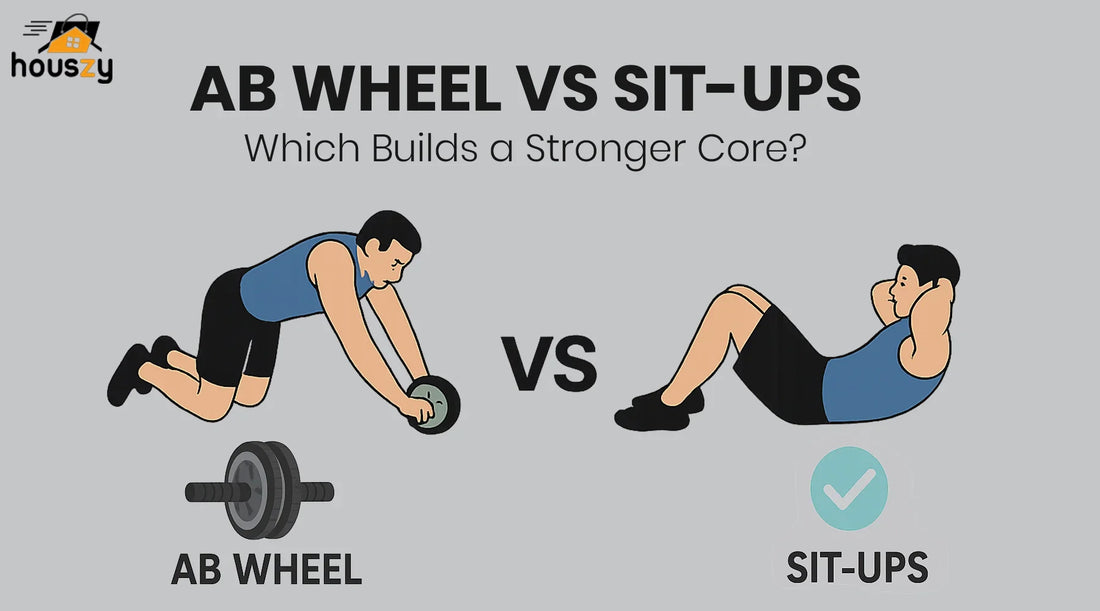
A stronger core doesn’t just improve how your abs look—it supports posture, stabilises movement, protects your lower back, and helps prevent injury. Two of the most widely practised core exercises are sit-ups and the ab wheel rollout. Sit-ups are simple, equipment-free, and popular across fitness levels. The ab roller wheel, on the other hand, has grown in popularity due to its ability to engage deep stabiliser muscles and deliver scalable results. In this blog, we compare both exercises—looking at effectiveness, safety, muscle engagement, and long-term benefits—to help you choose the right approach for building a stronger, more functional core.
Core Strength Explained: What Really Matters?
-
Core strength is more than visible six-pack abs. It’s about controlling and stabilising your body through every movement.
-
The most important core muscles include:
-
Rectus abdominis – the front-facing six-pack muscles
-
Transverse abdominis – deep internal muscles critical for spinal support
-
Obliques – muscles that control rotation and side-bending
-
Erector spinae and hip stabilisers – muscles that maintain balance and posture
-
A strong core improves:
-
Spinal alignment and upright posture
-
Injury prevention during physical activity
-
Athletic performance, especially in movements requiring balance or power
-
Effective core exercises should activate all major muscle groups, not just isolate the front of the abs.
Sit-Ups: Simplicity with Limits
-
Sit-ups involve curling the torso from a flat position to engage the rectus abdominis.
-
They're common in gym classes, home routines, and circuit training due to their ease and accessibility.
-
Benefits:
-
No equipment required – sit-ups can be done anywhere, making them accessible for beginners
-
Simple to learn – ideal for entry-level training or casual workouts
-
Great for endurance – useful in high-repetition core challenges
-
Limitations:
-
Minimal deep muscle activation – they often miss the transverse abdominis and stabilisers
-
Strain risk – poor form can lead to neck or lower back discomfort
-
Limited progression – they don’t scale well in resistance or complexity, making them less effective over time
Ab Wheel Roller: Compact but Comprehensive
-
The ab wheel roller is a compact tool designed for forward rollouts that target the full core.
-
It encourages controlled, resisted motion using your body weight to activate multiple muscle groups.
-
Muscles activated include:
-
Rectus abdominis and obliques – for motion and rotation control
-
Transverse abdominis and spinal erectors – for bracing and stability
-
Shoulders, arms, and back – providing stabilisation throughout the rollout
-
Equipment variations improve functionality:
-
Twin wheel ab roller – for increased balance during use
-
Ab roller with non-slip mat – provides knee support and slip resistance
-
Ab roller for beginners – often includes pull ropes or wall-stop guidance to limit overextension
Muscle Activation: Which Exercise Goes Deeper?
-
Sit-ups primarily train the rectus abdominis, with some involvement of the hip flexors.
-
In contrast, ab wheel rollouts activate a broader set of muscles, including:
-
The deep transverse abdominis
-
Obliques and rectus abdominis
-
Lower back muscles like the erector spinae
-
Secondary engagement in the shoulders and lats for stability
-
Studies using EMG (electromyography) consistently show greater muscle activation from ab wheel exercises compared to sit-ups.
-
The core exercise wheel encourages co-contraction of deep and surface-level muscles, making it far more comprehensive.
Safety & Injury Risk: Form Is Everything
-
Sit-ups, if performed with poor posture or high volume, can:
-
Stress the lumbar spine
-
Overactivate the hip flexors
-
Lead to neck strain due to improper hand placement
-
Ab roller exercises, although more advanced, promote:
-
Neutral spine posture—helping prevent spinal rounding
-
Slower, controlled movement – reduces risk of jerky motion
-
Braced abdominal engagement – stabilises the trunk and reduces impact on joints
-
For beginners, using an ab roller with a mat protects knees and encourages safer progression.
Progression & Long-Term Results
-
Sit-ups offer limited scalability:
-
You can add reps or hold a weight plate, but core activation plateaus quickly
-
It’s harder to increase resistance effectively
-
Ab rollers offer structured progression:
-
Start with shallow kneeling rollouts using a wall stop
-
Advance to full kneeling rollouts with longer range
-
Eventually progress to standing rollouts for full core overload
-
Using an ab roller wheel set with resistance bands allows additional scaling and variation, making it suitable for long-term fitness growth.
Time Efficiency & Workout Payoff
-
Sit-ups may require 50–100 reps per session to reach meaningful fatigue levels.
-
Ab roller workouts deliver results with just 10–12 high-tension reps:
-
Each rollout is a slow, controlled contraction engaging multiple muscle groups
-
Rest time is reduced as core and upper body work simultaneously
-
The best ab roller for abs allows for quick, efficient routines that burn out the core faster with fewer repetitions.
Equipment Needs & Practicality
-
Sit-ups:
-
Only require a soft surface, such as a yoga mat
-
Easy to perform anywhere without setup or planning
-
Ab wheel:
-
Small and travel-friendly—fits in a gym bag
-
Best used with a non-slip mat to protect knees and prevent slipping
-
Many models, like the ab roller wheel with pull ropes or dual wheels, provide extra functionality
-
Ideal for home workouts and space-limited training areas
Who Should Choose Sit-Ups?
-
Beginners starting out without access to equipment or space
-
Rehabilitation patients working on reintroducing core movement at low resistance
-
Group fitness or endurance classes focusing on high-rep bodyweight routines
-
Budget-conscious users who want an entry point into core training
Who Should Choose the Ab Wheel?
-
Fitness enthusiasts looking to challenge their core with a progressive tool
-
Intermediate to advanced users needing deeper activation and better long-term results
-
Home gym owners investing in compact, effective equipment
-
People wanting to improve functional strength across their boot, shoulders, and spine
-
Anyone looking for a versatile abs workout equipment that offers both stability and progression
Build Core Strength That Lasts
Stop wasting time on endless sit-ups. Upgrade your training with the Houszy ab roller wheel set, designed to target your entire core while protecting your joints. With a twin-wheel roller for added stability and a non-slip mat for knee support, it’s the ideal choice for home, gym, or on-the-go workouts. Shop now at Houszy.co.uk and power up your core with smart, effective equipment that delivers real results.


